
Essentials of Rock Physics Course – Stavanger
Eleanor Oldham will be heading to Stavanger, Norway, for 22-25th April to deliver the Essentials of Rock Physics and Seismic Amplitude Interpretation course.

Eleanor Oldham will be heading to Stavanger, Norway, for 22-25th April to deliver the Essentials of Rock Physics and Seismic Amplitude Interpretation course.

Understanding the properties of supercritical CO₂ is pivotal for accurate subsurface modelling. Read our latest blog post to learn more about this unfamiliar phase.

Only 4 days left until the BEOS show in London, where Merlin will be showcasing the East October Prospect, a ‘nugget’ located in the Gulf of Suez. Continue reading to find out more.
Knowledge gathered from decades of hydrocarbon exploration is vital to help us with our efforts in Carbon Capture and Storage (CCS). However, despite many parallels, there is a significant difference between natural migration of hydrocarbons and the flow of injected CO₂ underground. Robust modelling and simulation of CO₂ plumes is therefore required to fully understand fluid movements to ensure the safe and efficient storage of CO₂. This article looks at these similarities and differences and what it all means for the advancement of CCS going forward.

Bill Wilks, Eleanor Oldham and Georgina Lockham will be attending BEOS 2024! Come and say hello, we will be located at booth 46. Continue reading to find out more about the conference.
In her third and final article on rock physics for CCS, Eleanor Oldham discusses the pitfalls of seismic trace modelling for CCS workflows. The article focuses on how fluids are parametrised and how fluid substitution for CO₂ differs from hydrocarbons. Continue reading to learn more.

Following on from last week's blog, Eleanor Oldham continues to discuss the uses of Rock Physics for CCS with her latest article on 4D Seismic and Inversion. Learn about how 4D seismic can be used to visualise the movement of a CO₂ plume through time, how rock physics workflows can be utilised to make sure 4D surveys will be cost effective, and how seismic inversion provides a useful method of relating seismic amplitudes to CO₂ saturations and/or pressure increase.

Rock physics models allow us to characterise rock properties, and, when correctly applied, to de-risk amplitude driven hydrocarbon prospects. Many workers are now bringing rock physics methods to CCS challenges, but what questions can it answer and what limitations do we need to be aware of? Continue reading Eleanor Oldham’s latest blog post to find out.

The Business Exploration Opportunities Show (BEOS) is taking place on Tuesday 26th and Wednesday 27th March 2024, at the Business Design Centre, London, and Merlin is attending! We are look forward to meeting familiar faces and making new connections. We have a stand at booth 46 so please come along and say hello!
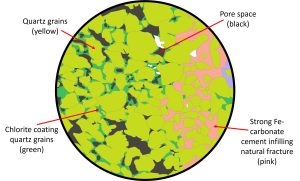
Sedimentology is a key factor in screening for and risking potential reservoirs for carbon storage sites. Having a good understanding of the environment of deposition, heterogeneity within the reservoir and pore-scale sedimentology is key to understanding how injected CO₂ will behave. It is important to make accurate geological models of the fluid pathways to de-risk potential storage units and ensure that the CO₂ we inject will be stored indefinitely. Continue reading to find out more.

On 6-7th March 2024, the FORCE biostratigraphy group are holding a conference at the Norwegian Offshore Directorate in Stavanger, with talks focusing on both the conventional and ‘less conventional’ applications of biostratigraphy. Our Principal Stratigrapher, Phil Copestake, will be attending and giving two talks. Continue reading for more information.